Content Strategy: How to Plan a Quarter of Blog Posts
 Anna Novak
A solid content strategy turns a blog from a stream of opportunistic posts into a system that compounds. The difference shows up in three places: which topics get written, what gets skipped, and how much each post borrows from the work that came before it. This guide walks through how to plan a full quarter — twelve weeks of publishing — instead of negotiating each topic on the Friday before it ships.
The premise is simple. A quarter is long enough to establish a topic cluster, run a meaningful refresh, and review what worked. It is short enough that the plan stays honest with the data. Below, the framing covers audit, search demand, editorial mix, calendar building, resource mapping, linking, KPIs, and the mid-quarter review. Each section is methodical because, in practice, that is what separates a calendar that survives Mondays from a wishlist that does not.
Why Plan a Full Quarter Instead of Week by Week
Weekly planning has an obvious appeal. It is responsive, it absorbs new ideas, and it never feels stale. However, the cost is that every Monday becomes a topic-selection meeting. Decisions made under deadline pressure tend to favor the loudest idea, not the strongest one.
Quarterly content strategy shifts the decision-making earlier. Instead of asking “what should we write this week?”, the question becomes “does this topic still earn its slot, given what we know now?”. Importantly, the second question can be answered with data — search trend, internal link gaps, decay metrics — while the first usually cannot.
For example, a quarter is also the smallest unit at which topic clusters become visible. A pillar page published in week 1 with three spokes following in weeks 2, 3, and 6 starts behaving as a cluster by week 8. Spoke-to-pillar internal links accumulate, the pillar gains topical authority, and the cluster begins ranking together. None of that happens in a week-by-week mode where each post sits alone.
That said, quarterly planning is not rigid scheduling. It is a forecast that gets revised. The mid-quarter review at week 9 exists precisely so the plan can adapt to reality without abandoning structure entirely.
Audit First: What’s Already Earning, What’s Decaying
Before adding twelve new posts, the existing library deserves a careful look. Specifically, three categories matter: posts that earn organic traffic and are still climbing, posts that earned in the past but are decaying, and posts that never gained traction. Each calls for a different action.
For climbing posts, the strategy is to leave them alone or build supporting spokes around them. For decaying posts, a refresh — updated data, expanded sections, new internal links — often outperforms writing something net-new on the same topic. For posts that never gained traction, the honest move is usually to consolidate them into a stronger article or unpublish.
The audit produces three lists by the end:
- Keep and amplify: 5-10 posts to add internal links toward, possibly add spokes
- Refresh: 2-4 posts where a substantial update can recover traffic
- Consolidate or retire: low-performing posts that dilute topical authority
Tools like Ahrefs Site Explorer or Search Console make this exercise concrete. Decay is usually visible as a 30-50% drop in clicks over six months on a page that previously held a stable position. Furthermore, a refresh slot in the calendar is one of the highest-leverage actions a quarter can include — Brian Dean has documented cases on Backlinko where republishing alone produced double-digit traffic recovery.
The Search-Demand Layer: Topic Clusters and Pillar Pages
Search demand drives most evergreen organic traffic. Therefore, the plan should map directly to clusters: a pillar page covering a broad topic, surrounded by spokes that target long-tail subtopics. The pillar tends to rank for the head term over time; the spokes rank earlier for narrower queries and feed authority back to the pillar through internal links.
Cluster identification starts with two inputs. First, a list of head terms relevant to the audience and product. Second, a long-tail keyword pull from a tool like Moz Keyword Explorer or Search Console’s existing impressions data. Clusters emerge from grouping the long-tail by intent and entity overlap, not by raw keyword similarity.
A practical rule: if a pillar page is the answer to “what is X?”, spokes are answers to “how do I X?”, “X vs Y?”, and “X for Z context?”. Each spoke should defensibly link upward to the pillar. If a spoke does not naturally reference the pillar, it likely belongs in a different cluster.
Animalz publishes useful work on this — their Animalz blog covers pillar/spoke architecture and the editorial decisions behind it. In particular, the principle of writing the pillar before the spokes (so the spokes can be deliberately scoped) is worth following.
The Editorial Mix: Cornerstone vs Spoke vs Newsworthy
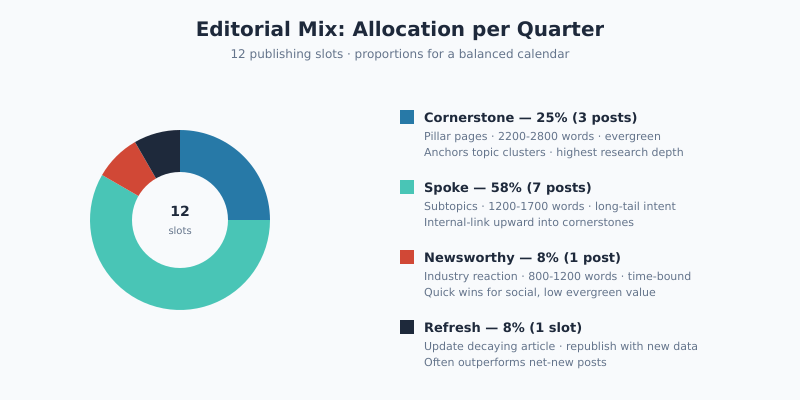
A quarter has roughly 12 publishing slots if the cadence is one post per week. How those slots split between post types matters more than people typically assume. A reasonable allocation, validated by experience and by Ross Hudgens’ commentary on Siege Media’s content strategy approach, looks like this:
| Post type | Share | Slots (of 12) | Words | Purpose |
|---|---|---|---|---|
| Cornerstone (pillar) | 25% | 3 | 2200-2800 | Anchor topical authority, evergreen |
| Spoke | 58% | 7 | 1200-1700 | Long-tail intent, link upward |
| Newsworthy | 8% | 1 | 800-1200 | Industry reaction, social wins |
| Refresh | 8% | 1 | +800 added | Recover decaying content |
The exact percentages can shift. A site without an existing library has nothing to refresh, so the refresh slot reallocates to spokes. A site with a strong news angle (B2B SaaS in a moving regulatory space, for example) might double the newsworthy share at the cost of cornerstones. Nevertheless, three principles hold across configurations.
First, cornerstones are the rarest and the most expensive. Second, spokes are the workhorse — they are also the easiest to underestimate in cost, since each one still needs proper research and editing. Third, newsworthy posts produce social and email value but rarely earn long-term organic traffic; treat their KPIs separately.
Building the 12-Week Calendar
A 12-week calendar fits naturally into three monthly themes. Month 1 establishes the first cluster: one cornerstone, two spokes, one refresh. Month 2 expands into the second cluster while reusing internal links across months. Month 3 closes with synthesis — a third cornerstone, the final spokes, and a quarter-end roundup.
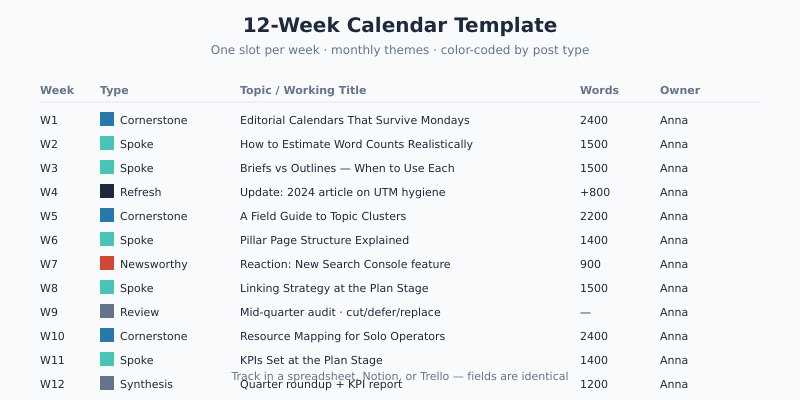
The calendar is not a list of titles. It is a list of slots with the following fields filled in for each:
- Week number — fixed, drives publish date
- Type — cornerstone, spoke, newsworthy, refresh
- Working title — refined later, but committed enough to avoid scope creep
- Cluster — which pillar this post belongs to
- Target keyword — primary query the post is built around
- Word count target — drives time estimation
- Internal links planned — to and from which existing posts
- Owner — even for solo operators, naming the owner clarifies priority
- KPI proxy — what success looks like at week 4 and week 12
A useful sanity check: read down the column of working titles. If two posts could plausibly be the same article, one of them is redundant. If the cluster column shows a pillar with no spokes scheduled in the same quarter, the pillar will not benefit from internal linking until next quarter — which may or may not be acceptable.
Aleyda Solis, in her work on SEO editorial calendars, emphasizes that the calendar should also reserve white space. A slot left as “TBD until week 9 review” is more honest than filling all twelve in advance and pretending nothing will change.
Resource Mapping: Word Count, Research, Visuals, Editor Cycles
Word count alone does not predict effort. A 1500-word spoke that depends on synthesizing five research papers takes longer than a 2200-word cornerstone built around an existing internal framework. Therefore, resource estimation works best when broken into four components: research, drafting, editing, and visuals.
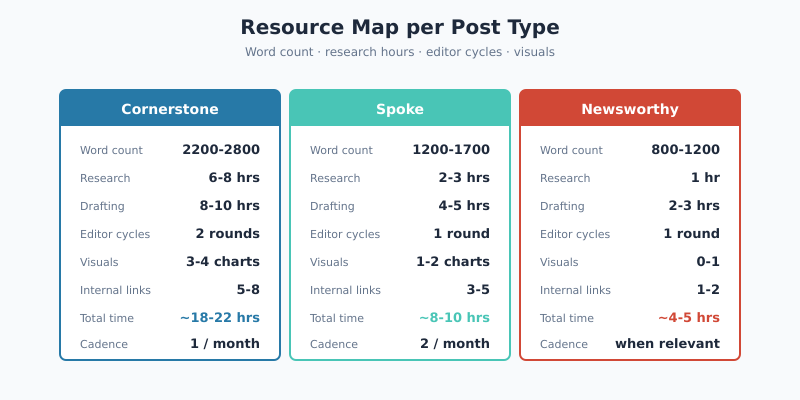
The table above gives realistic ranges for a solo operator or small team. A few patterns are worth noting. Cornerstones spend a disproportionate share of their time in research (6-8 hours) — the depth of the eventual draft depends on it. Spokes invert the ratio, with most time in drafting because the research is narrower. Newsworthy posts are dominated by speed; if they take longer than a day, the news cycle has usually moved on.
For each draft, a word counter tool helps catch over-writing early. If a spoke is supposed to be 1500 words and the draft is at 2200, that is a structural signal — usually the post is trying to be both spoke and cornerstone. The Word Counter tool on this site shows live word, character, and reading-time stats, which makes this kind of self-check fast at the planning and drafting stage.
Editor cycles deserve a separate mention. Two rounds for cornerstones and one for everything else is a defensible default. Specifically, the first round addresses structure (does each section earn its place?), and the second addresses prose (does each paragraph earn its length?). Skipping the first round in favor of two prose passes is a common mistake — structural problems are cheap to fix early and expensive to fix late.
Linking Strategy: Inbound and Outbound at the Plan Stage
Internal linking is most often treated as a post-production task. That is a mistake. The most defensible internal links are the ones planned before drafting, because they shape the structure of the post itself.
At the plan stage, three types of links should be assigned to each post. Upward links from spokes to their pillar — the cluster’s defining structure. Lateral links between spokes in the same cluster, where useful. Inbound links from existing posts that should reference the new post once published; these are added during the post-publish week.
External outbound links serve a different purpose. They establish trust by showing the article engages with the broader literature on its topic. A reasonable target is three to six outbound links per cornerstone, two to three per spoke, and zero to one per newsworthy post. The links should go to authoritative sources — research, official documentation, or recognized practitioner blogs — and not to thin commercial pages. Practical guidance on internal linking patterns is also covered in the content readability guide, which includes how link density affects readability scores.
One operational tip: maintain a “link map” spreadsheet alongside the calendar. Each row is a post, each column is another post, and a marked cell means “link planned in that direction”. The map makes orphan posts visible (no inbound or outbound) and over-linked posts visible (every other post links to it). Both are signals that something needs adjusting.
KPI Setup at the Plan Stage
KPIs set at the plan stage — not retroactively — give the mid-quarter review something to measure against. Three categories cover most use cases without overcomplicating the dashboard.
Search performance tracks impressions and organic clicks at week 4 and week 12 per published post. Impressions move first (sometimes within days), so they signal whether the post is being found at all. Clicks follow, usually with a 4-8 week lag for spokes and longer for cornerstones.
Engagement proxies track scroll depth, time on page, and internal link click-through. These are imperfect signals individually but converge on a useful pattern: a post with high impressions, low clicks, and low time-on-page is usually a meta-description or title issue. The meta descriptions guide covers the rewrite playbook for that specific failure mode.
Conversion proxies track newsletter signups, tool usage, or whatever the site’s nearest commercial action is. Importantly, conversion KPIs are slow signals — three months is barely enough to see a trend. Therefore, set conversion KPIs at the cluster level, not per post.
The simplest KPI table looks like this:
| Post type | Week 4 target | Week 12 target | Failure threshold |
|---|---|---|---|
| Cornerstone | 500+ impressions | 2000+ impressions, 50+ clicks | <200 impressions at week 12 |
| Spoke | 200+ impressions | 800+ impressions, 30+ clicks | <100 impressions at week 12 |
| Newsworthy | Social shares + email opens | n/a (time-bound) | <5% open rate |
| Refresh | Recovery to prior peak | +20% above prior peak | No recovery at week 12 |
The failure threshold matters more than the targets. A target gives optimism a number. A failure threshold gives the mid-quarter review a clear trigger to act on.
Mid-Quarter Review: When to Cut, Defer, or Replace
Week 9 is the natural review point. By then, posts from weeks 1-5 have four-plus weeks of search data, the cluster from month 1 has settled into its early ranking, and there is enough information to revise weeks 10-12.
The review covers three questions. First, are any planned posts no longer relevant? A topic that seemed promising in week 0 may have been overtaken by a competitor, an industry change, or a Google update. If so, defer or replace.
Second, are any posts at the failure threshold? A spoke at week 5 with under 50 impressions is a flag. Diagnose before reacting — sometimes the problem is indexing, sometimes a thin draft, sometimes a misjudged keyword. Subsequently, decide whether to expand the post, refresh it, or accept the loss.
Third, are there emerging clusters worth pulling forward? If month 1’s cornerstone is performing above expectation, the mid-quarter review is the right moment to add a fourth spoke in weeks 10-12, even if it displaces a less-defensible post.
The review produces a revised calendar for weeks 10-12, not a wholesale rewrite. Specifically, the goal is small directional adjustments based on real data, not the temptation to scrap the plan entirely. Plans that get scrapped at week 9 usually had structural problems at week 0 — and the right response is to keep notes for the next quarter, not to abandon this one.
Tools and Templates: Spreadsheet, Trello, Notion
The calendar itself can live in any tool. The fields are identical across them; what changes is the team’s preference for views and notifications. Three common setups:
- Spreadsheet (Google Sheets, Airtable): best for a single owner, offers a clear table view and easy filtering. Airtable adds linked records for cluster relationships.
- Notion: best for small teams that want the calendar, briefs, and reference material in one place. Database views (calendar, board, table) make role-switching easy.
- Trello: best for kanban-style workflow tracking — Drafting, In Review, Scheduled, Published. Less effective as a planning surface, more effective as a status surface.
Whichever tool, three templates are worth maintaining. A brief template for each post (working title, target keyword, outline, links, word count target). A review checklist applied before publishing (structural pass, prose pass, link audit, image alt text, meta description). A retrospective template filled in at week 12 with what worked, what missed, and what to repeat.
For solo operators, the brief template is the single highest-leverage document. A 30-minute brief saves several hours of drift during drafting. As a starting point, a useful brief includes: the question the post answers, the audience reading it, the three claims the post must make, the supporting evidence for each claim, and the next action the reader should take.
Bringing It Together
A content strategy for a quarter is, ultimately, a forecast made honest by structure. Twelve slots, broken into clusters, mapped to resources, linked deliberately, measured against pre-set KPIs, and revised mid-quarter. None of those steps is exotic. The discipline is in not skipping any of them.
The Word Counter tool is a small but useful companion through this process — at the plan stage to set realistic word-count targets, at the drafting stage to catch over-writing early, and at the publishing stage to confirm the post matches its slot. Try the Word Counter tool next time a draft starts feeling longer than the calendar said it should be. A spoke that wants to be 2200 words is usually a cornerstone in disguise — and catching that before the editor cycle is worth the thirty seconds it takes to check.