Keyword Density: How Many Times Should a Keyword Appear?

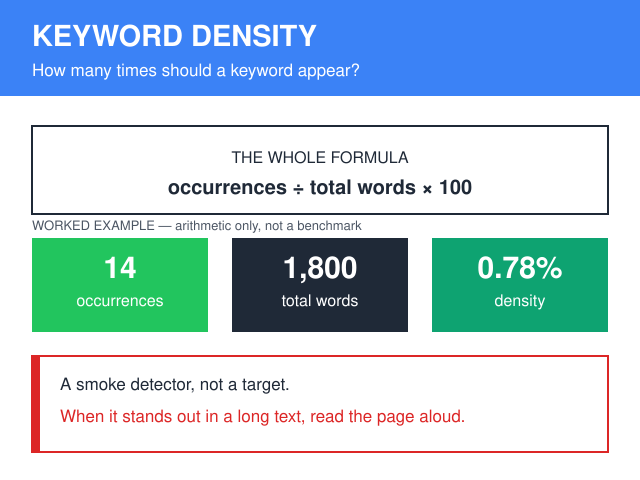
There is no target keyword density. The number is trivial to compute — divide the times a phrase appears by the total word count, then multiply by 100 — but no threshold in that formula maps to a ranking outcome. Run the arithmetic once as an illustration: an article of 1,800 words that uses its phrase 14 times sits at 0.78%. Google’s John Mueller has said the metric is “something I wouldn’t focus on”, adding that content should be written in a natural way. So the percentage earns its keep in exactly one role: as a smoke detector. In the ordinary range it tells you nothing you did not already know from reading the draft. When it climbs far enough to stand out in a long text, it usually means somebody typed the phrase in by hand instead of writing sentences. Treat it as an alarm, never as a goal.
What is keyword density, and how do you calculate it?
Keyword density is the share of a text made up of one specific phrase, expressed as a percentage. The arithmetic has not changed since the metric was invented:
density % = (occurrences ÷ total words) × 100Run it on the example above. A draft of 1,800 words contains the phrase 14 times. Divide 14 by 1,800 and you get 0.00777. Multiply by 100 and the density is 0.78%. That is the entire calculation — one division, one multiplication, no weighting, no adjustment for how good the writing is.
The hard part is deciding what counts as an occurrence, because three defensible answers exist. A strict counter matches only the phrase exactly as typed. A stemming counter folds plurals and verb forms together, so “train”, “trained” and “training” all register as the same term. A third approach counts a short phrase every time it appears inside a longer one, which inflates the total whenever your keyword is a common two-word string.
Then there is the question of scope. Body-text density normally excludes the title tag, the meta description and image alt attributes, for a practical reason: those fields are not part of the reading experience, and mixing a handful of metadata hits into a body count distorts a short page badly. Some auditing tools include them anyway, and they rarely say so on screen.
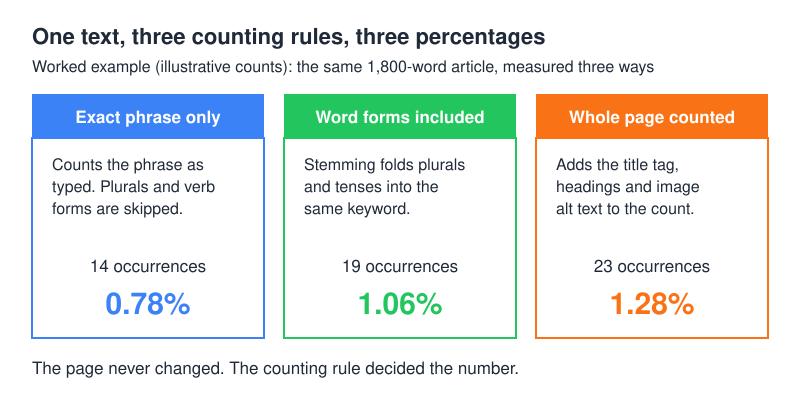
This is why two tools hand you different percentages for one unchanged page. As an illustration, run all three rules over the same 1,800-word draft: the strict counter finds 14 occurrences, stemming lifts that to 19, and adding title, headings and alt text brings it to 23 — 0.78%, 1.06% and 1.28% for a page in which not one word changed. Yoast SEO makes its rules unusually explicit: its documentation on keyphrase density states that the free plugin counts the focus keyphrase only, that Premium and the Shopify version recognise word forms in supported languages, and that synonyms never count toward the density score in either one. Two products from the same vendor therefore disagree with each other by design. A density figure quoted without its counting rule is not a measurement — it is a rumour with a decimal point.
Why does the “1–3% rule” still circulate?
The rule is a fossil from a search engine that no longer exists. Early ranking systems leaned heavily on term frequency, so repeating a phrase genuinely moved a page up, and practitioners reverse-engineered a comfortable band that got results without tripping the crude spam filters of the day. The same era produced the keywords meta tag, a field where you simply listed the terms you wanted to rank for. It was abused so completely that search engines abandoned it; Google’s documentation still states that “the meta-keyword tag is not used by Google Search, and it has no effect on indexing and ranking at all”.
What followed was a run of updates — Panda, Hummingbird, and eventually BERT — that shifted the system from matching strings toward interpreting meaning. Google’s BERT announcement, published in October 2019, described models that “consider the full context of a word by looking at the words that come before and after it”, and said the model would help Search better understand one in 10 searches in the U.S. in English. A system that parses context has no use for a repetition quota.
Yet the rule survived its own extinction event, for two unglamorous reasons. First, density is the only on-page quality signal that is trivial to automate — you cannot script “is this paragraph any good”, but you can script a division. Second, plugins reward a range with a green light, and a green light feels like an instruction. Yoast SEO’s free analysis turns green when density lands between 0.5% and 3%, and the same documentation puts the ceiling at 3.5% in Premium and Shopify, because recognising word forms widens the count. Those are scoring bands inside one plugin, not a threshold inside a search engine.
Google’s own guidance is blunt about numeric targets of this kind. Its self-assessment questions for creators ask whether you are “writing to a particular word count because you’ve heard or read that Google has a preferred word count? (No, we don’t.)” The same logic applies one level down, to the count inside the count.
What density does natural writing actually produce?
Rather than chase a number, look at what the arithmetic returns when nobody is optimising for it. The table below is a worked example rather than a survey: it runs the formula on five page lengths, with occurrence counts written to stand for an unforced draft — a phrase in the H1, one in the opening, a few across subheadings, and the rest scattered where the sentence needed it. Every percentage in it is a division, not a measurement.
| Page type | Illustrative length | Illustrative occurrences | Resulting density | What to check instead of the percentage |
|---|---|---|---|---|
| Pillar guide | 3,500 words | 20 | 0.57% | Subtopic coverage against the pages already ranking |
| Blog post | 1,800 words | 14 | 0.78% | Whether each H2 answers a genuinely distinct question |
| Service page | 900 words | 9 | 1.00% | Whether the offer, scope and coverage area are stated plainly |
| Product description | 400 words | 6 | 1.50% | Attribute coverage: size, material, compatibility, fit |
| Landing page | 250 words | 5 | 2.00% | One promise, one action, zero filler |
Read the pattern down the last two columns. Within the example the density climbs from 0.57% to 2.00% while the writing gets less elaborate, not more optimised. Nothing improved between the first row and the last — the denominator simply shrank. A landing page hits 2% because 250 words cannot absorb five mentions without them showing.
Comparing percentages across page types is therefore meaningless, and comparing your page to a competitor’s percentage is worse, because you are comparing two denominators you did not choose. Length itself follows intent rather than a target, which is the argument made in detail in our guide to how long content should be.
When is a high keyword density an actual problem?
Sometimes the alarm is real. The symptoms, though, are structural rather than numeric, and you can spot every one of them without a calculator:
- The exact phrase opens every H2, in the same grammatical shape each time.
- Internal links all carry the identical anchor text.
- Every image alt attribute repeats the keyword instead of describing the image.
- The first paragraph and the last paragraph restate the phrase in nearly the same sentence.
- Sentences bend around the phrase, producing constructions no one would say aloud.
Those are the fingerprints of insertion, and Google names the practice directly. Its spam policies define keyword stuffing as “the practice of filling a web page with keywords or numbers in an attempt to manipulate rankings in Google Search results”, listing blocks of city and region names and repetition that “sounds unnatural” among the examples. Note what the policy measures: unnaturalness, not arithmetic.
The cheapest diagnostic costs a minute. Read the suspect section aloud. If you stumble, or if a sentence makes you wince, the defect lives in the syntax — and fixing syntax fixes the percentage as a side effect. Our piece on writing for humans and search engines covers the sentence-level habits that keep this from happening in the first place.
The reverse case deserves equal attention. A page sitting far below the range a plugin likes is not under-optimised if the topic is genuinely covered; it may simply be long, or written by someone who uses pronouns. Adding mentions to a page that already answers the question improves nothing except a plugin bullet.
What should you count instead of keyword density?
Swap the single percentage for a short list of checks that describe coverage rather than repetition. Each one takes longer than a division, and each one corresponds to something a reader would notice.
- Variant coverage. Confirm the page uses the natural range of phrasings — plural, singular, verb form, the question form people actually type. A page that states its subject one way only tends to read as though it were built around a string rather than a topic.
- Subtopic coverage. List the questions the current top results answer. Any question you skip is a real gap; a low percentage is not.
- Placement, not frequency. The phrase belongs in the H1, the title tag and somewhere in the opening lines, because those positions tell a reader they landed correctly. After that, placement stops mattering.
- Entity coverage. Check that the related names, tools, standards and concepts a knowledgeable writer would mention are present. Breadth of vocabulary signals depth; repetition signals nothing.
- Anchor variety. Vary the wording of internal links pointing at the page. Identical anchors across a site read as a pattern rather than as editorial choice.
- One page per intent. If two of your URLs chase the same phrase, no density adjustment will help either of them. Merge them.
Six checks replace one number, and unlike the number, every item on the list changes what the page is worth to somebody reading it.
How do you check keyword density on a page in under a minute?
You still want the figure occasionally — as a sanity check on a draft that feels repetitive, or when auditing pages somebody else wrote. Three approaches cover almost every case.
- Paste the draft into a counter. Drop the body text into our word counter and read the density block alongside the word and sentence totals. Because you paste body text only, metadata stays out of the count automatically.
- Use Ctrl+F on the published page. Browser find returns a match count instantly, with no copying. Divide that by the word count you already know. It counts visible text only, which is usually what you want.
- Batch it in a spreadsheet. For a set of URLs, put occurrences in one column and word count in the next, then apply
=occurrences/words*100and sort descending. Only the top of that sorted list is worth opening.
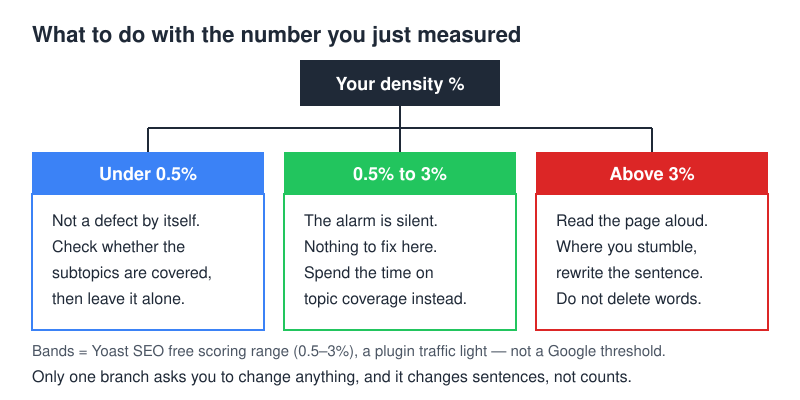
What you do next matters more than the measurement. If the figure sits in the range your plugin is happy with, close the tab. If it stands out in a substantial text, open the page and rewrite the sentences that carry the phrase — recast them, use a pronoun, split a clause. Deleting individual keywords to hit a number produces a page optimised for a plugin and slightly worse for everyone else.
Frequently asked questions
Is keyword density a Google ranking factor?
No documented threshold exists, and Google’s public position has been consistent for years: John Mueller has described it as something he would not focus on, recommending natural writing instead. Google’s spam policies address the extreme case — stuffing — by describing how the text reads, not by naming a percentage.
What is a good keyword density percentage?
There is no good percentage. Unforced writing lands low on a long page and higher on a very short one, purely because the denominator changes — the figure describes length far more than it describes optimisation. Yoast SEO’s free analysis awards a green bullet between 0.5% and 3%, which is a plugin scoring band rather than a search engine threshold.
Do the title tag and meta description count toward keyword density?
Usually not. Body-text density conventionally covers the visible content of the page, since metadata is not part of the reading experience and a couple of extra hits skews a short page noticeably. Some crawlers include title, headings and alt text in the total, which is one reason two audits of one page disagree.
Can low keyword density hurt rankings?
Not on its own. A very low figure occasionally reveals a page that never states its subject plainly — worth checking that the phrase appears in the H1 and the opening lines. If the topic is covered and the page reads clearly, a low percentage is a description of your writing style, not a defect to repair.
Do synonyms and word variations count as the same keyword?
That depends entirely on the tool. Stemming counters treat plurals and verb forms as one term; strict counters do not. Synonyms are excluded from Yoast’s density score in every version, even though the same plugin encourages using them elsewhere in the analysis. Always check which rule your tool applies before comparing two numbers.