How Long Should Content Be? Word Count and SEO
 Anna Novak
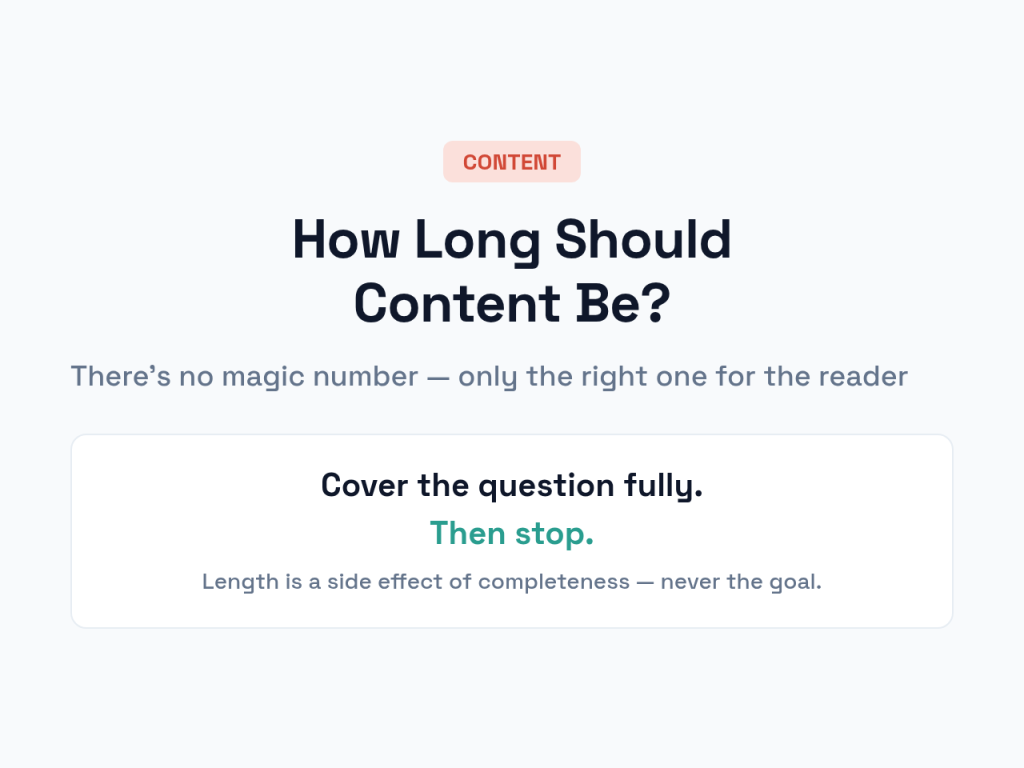
“How many words should my page be?” is one of the most-asked SEO questions, and almost every answer you’ll hear is wrong. There’s no magic number — not 1,000, not 2,000, not 300. The pages that win aren’t the longest; they’re the ones that answer the question completely and then stop. This guide replaces the word-count myth with the rule that actually drives rankings: match your length to what the searcher needs.
You can check any draft’s length instantly with our word counter, but knowing what number to aim for matters more than hitting one. Let’s get that right.
The Word-Count Myth
Somewhere along the way, “long content ranks better” hardened into a rule, and writers started padding articles to hit arbitrary targets. The correlation is real but the causation is backwards.
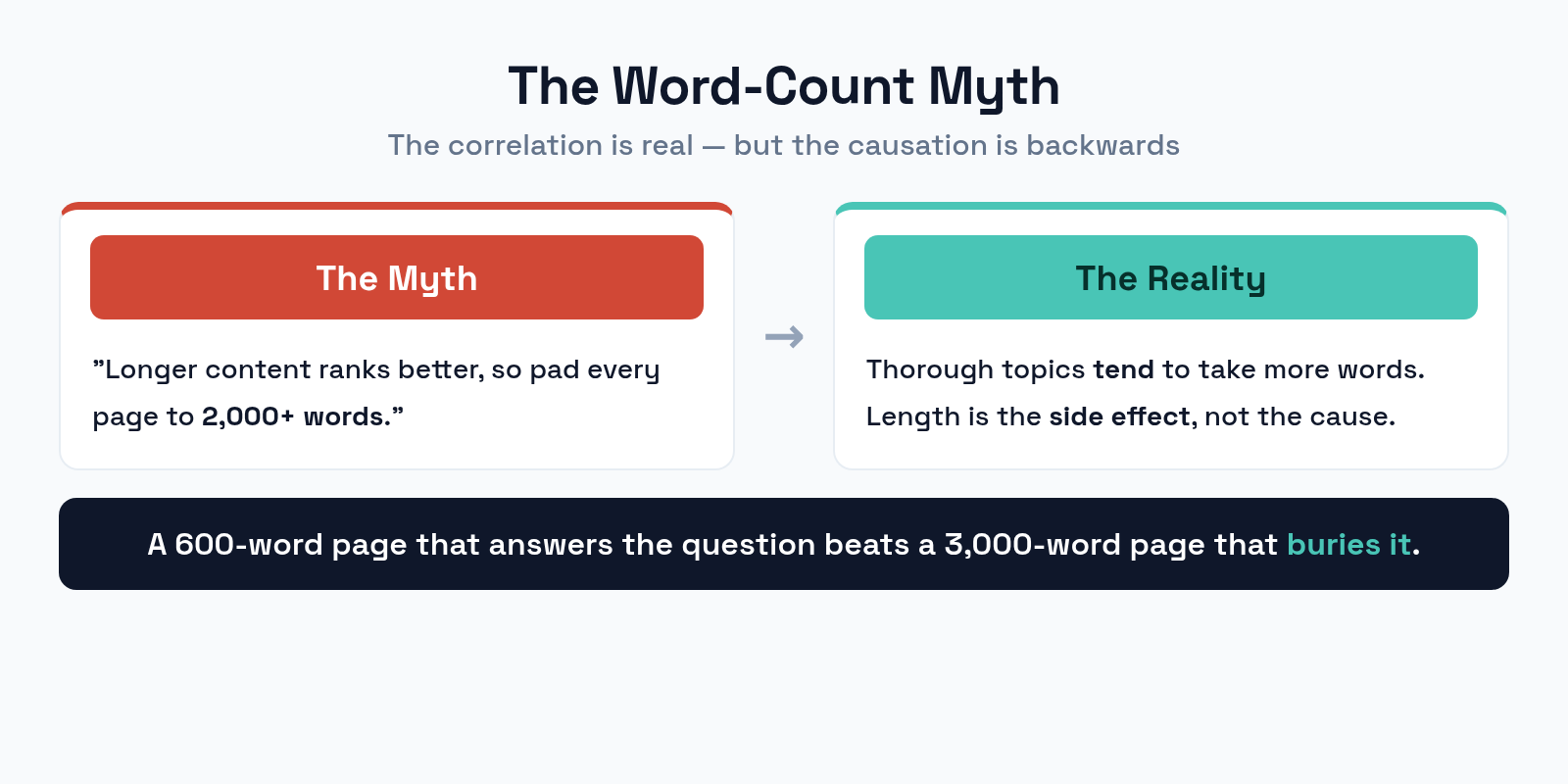
Longer articles often rank well not because they’re long, but because thoroughly covering a topic tends to take more words. Length is a side effect of completeness, not a cause of ranking. Search engines don’t count your words and reward a number — they assess whether your page satisfies the searcher. A 600-word page that fully answers a simple question beats a 3,000-word page that buries the answer under filler. Word count is a symptom of good content, never the goal.
Length Follows Search Intent
The right length is set by one thing: what the person searching actually wants. Different questions need different amounts of answer.
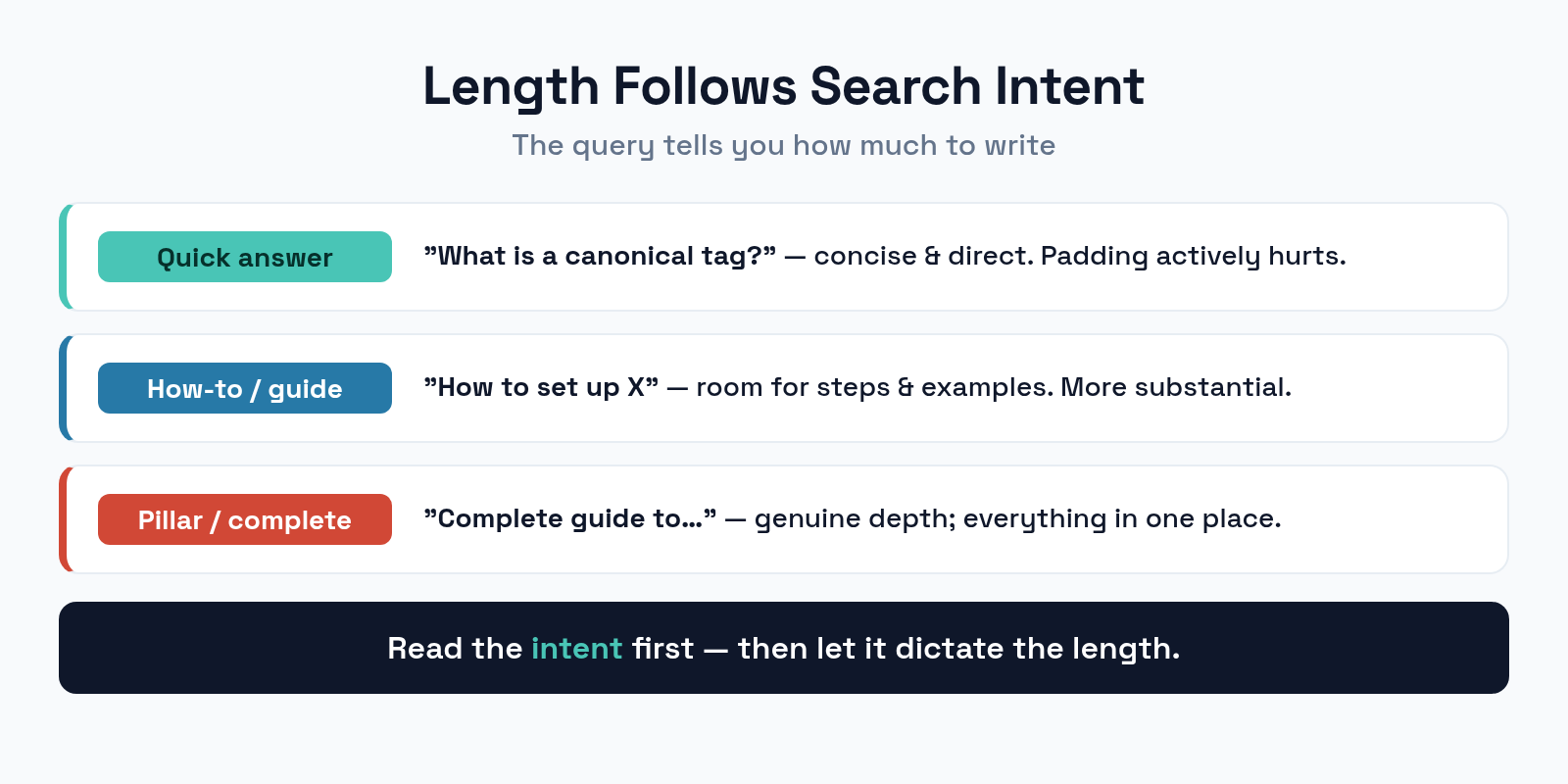
A quick-answer query — “what is a canonical tag” — needs a clear, concise response; padding it to 2,000 words actively hurts, because the reader wanted the answer fast. A how-to or guide query needs enough room to walk through the steps with examples, typically more substantial. A comprehensive or pillar query — “complete guide to technical SEO” — genuinely calls for depth, because the searcher wants everything in one place. Read the intent first, then let it dictate the length. The query tells you how much to write.
Why Thin and Padded Content Both Fail
There are two ways to get length wrong, and they fail for opposite reasons.
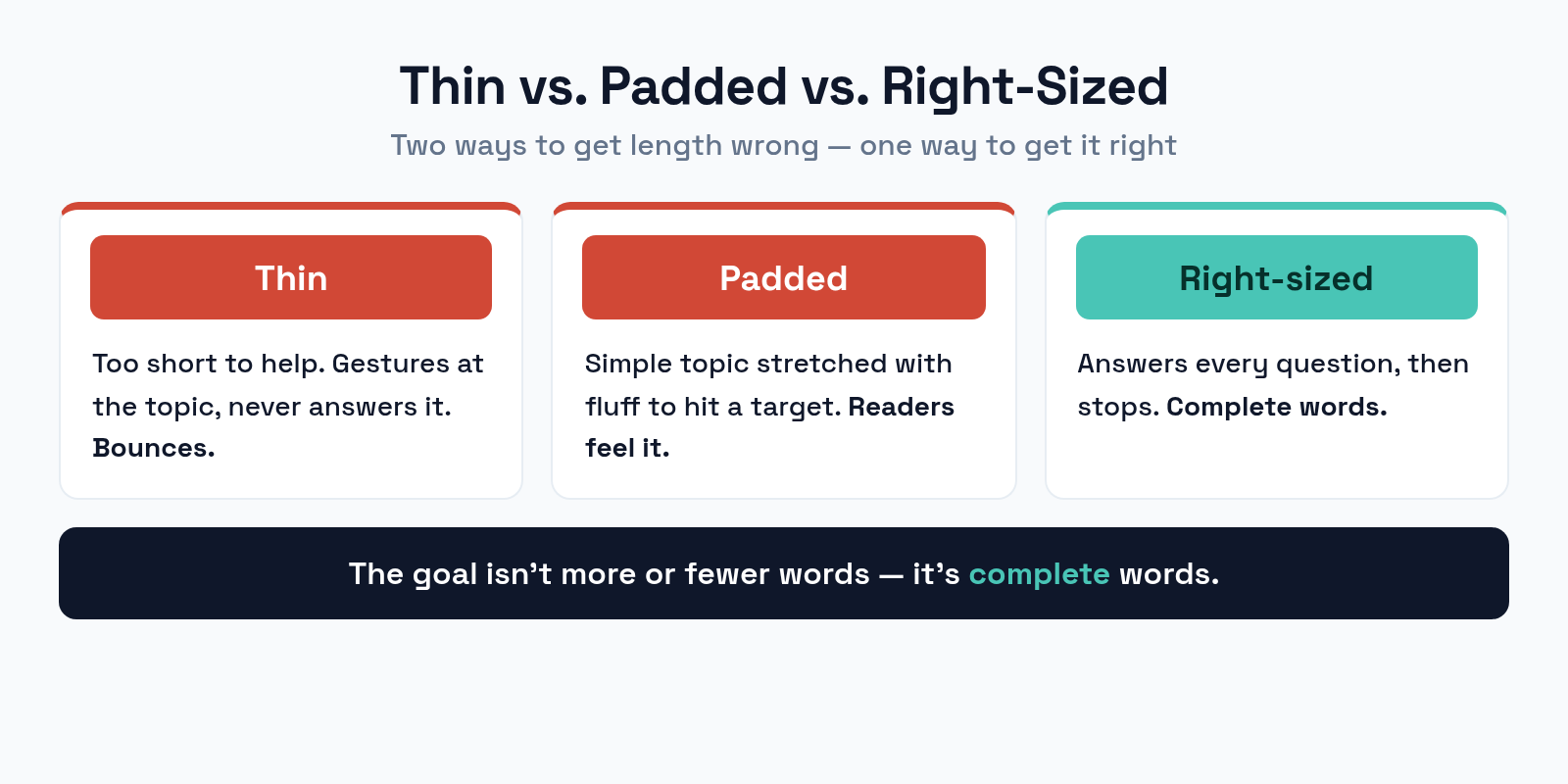
Thin content is too short to be useful — a 150-word page that gestures at a topic without answering it. Search engines see it as low-value, and visitors bounce. Padded content is the opposite failure: a genuinely simple topic stretched with fluff, repetition, and throat-clearing to hit a word target. Readers feel the filler and leave before the point. Right-sized content covers the topic fully — every question a reader has — and then stops. The goal isn’t more words or fewer words; it’s complete words. Say everything that helps, and nothing that doesn’t.
How to Find the Right Length
Instead of guessing a number, let the topic and the competition tell you. The process is simple and repeatable.
First, identify the intent behind your keyword — is the searcher after a quick fact, a tutorial, or a deep dive? Second, look at what currently ranks; the top results reveal the depth searchers expect for that query, not as a target to copy but as a signal of intent. Third, list every sub-question a reader might have and answer each one. Fourth, cut everything else. When you’ve answered every real question and removed every sentence that doesn’t add value, you’ve found the right length — whatever number it happens to be.
Readability Beats Length
How you structure those words matters more than how many there are. A well-organized 1,500-word article outperforms a wall-of-text 3,000-word one every time.
Break content with clear headings, keep paragraphs short, use lists and tables where they help, and front-load answers so a scanner finds what they need fast. A reader who can navigate your page quickly perceives it as helpful regardless of its length — and that perception drives the engagement signals that actually correlate with ranking. Length without structure is just a longer way to lose people. For more on this, see our guide to content readability.
Common Content-Length Mistakes
Most length problems trace back to chasing a number instead of serving a reader. Avoid these.
- Writing to a word target. “This needs to be 2,000 words” leads to padding. Write until the topic is covered, then stop.
- Padding simple topics. If a question has a 400-word answer, give a 400-word answer. Stretching it drives readers away.
- Publishing thin pages. A page too short to help anyone won’t rank. Either expand it to real value or merge it into a stronger page.
- Copying a competitor’s count. The top result’s length signals intent, not a number to match. Cover the topic better, not just longer.
- Ignoring structure. A long page with no headings or breaks reads as a chore. Format for scanning, whatever the length.
Frequently Asked Questions
Is there a minimum word count for SEO?
No. There’s no official or effective minimum. Very short pages can struggle simply because they often fail to cover a topic, but a concise page that fully answers a simple query ranks fine. Completeness, not a word floor, is what matters.
Do longer articles rank better?
Not because they’re longer. Longer content often ranks well because thorough topics take more words — but length is the side effect, not the cause. A focused short page beats a padded long one on the same query every time.
How do I know if my content is long enough?
It’s long enough when it answers every question a reader could reasonably have about the topic, and not a sentence longer. If you can’t think of an unanswered question and there’s no filler to cut, you’ve hit the right length.
Does word count affect readability scores?
Indirectly. Readability depends on sentence and paragraph length, structure, and clarity — not total word count. A long article can be highly readable and a short one hard to follow. Focus on structure and clarity rather than the total.
The Bottom Line
Stop asking how many words your page needs and start asking what your reader needs. Length follows search intent: a quick query wants a quick answer, a guide wants depth, a pillar wants everything. Cover the topic completely, cut every sentence that doesn’t earn its place, and structure it so readers can scan. The right word count is simply however many words it takes to fully answer the question and not one more. Serve the searcher, and the length takes care of itself.