How to Calculate Marketing ROI: Formulas and Examples
 Anna Novak
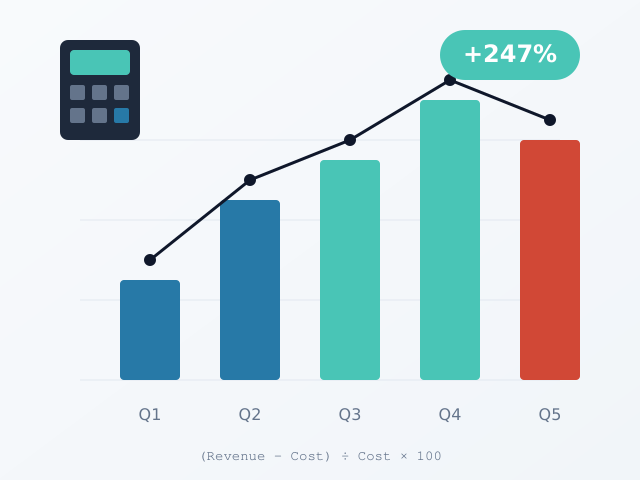
Marketing ROI measures the return generated from your marketing investments. Understanding how to calculate marketing ROI helps you identify which campaigns deliver value and which drain your budget. Without this knowledge, you’re essentially flying blind — spending money on activities that may or may not contribute to your bottom line.
This guide covers everything you need to know about marketing ROI calculation. You’ll learn the basic formula, explore advanced variations, and see practical examples across different campaign types. By the end, you’ll confidently measure the effectiveness of any marketing initiative.
What Is Marketing ROI?
Marketing ROI (Return on Investment) quantifies the revenue generated relative to the cost of your marketing efforts. In simple terms, it answers the question: “For every dollar spent on marketing, how much did we earn back?”
This metric matters because marketing budgets face constant scrutiny. Executives want proof that marketing contributes to revenue, not just brand awareness or engagement metrics. Consequently, marketers who demonstrate clear ROI secure larger budgets and greater organizational influence.
However, marketing ROI differs from general business ROI in important ways. Marketing investments often produce delayed returns, making attribution challenging. Furthermore, some marketing activities build long-term brand equity that’s difficult to quantify immediately. Despite these challenges, calculating marketing ROI remains essential for data-driven decision making.
The Basic Marketing ROI Formula
The fundamental marketing ROI formula is straightforward:
Marketing ROI = (Revenue from Marketing − Marketing Cost) ÷ Marketing Cost × 100
This formula expresses ROI as a percentage. A positive percentage indicates profit, while a negative percentage indicates loss. For example, an ROI of 150% means you earned $1.50 for every dollar spent, resulting in a net gain of $0.50 per dollar invested.
Breaking Down the Components
Before calculating, you must accurately define each component:
- Revenue from Marketing: The income directly attributable to your marketing efforts. This requires proper tracking and attribution.
- Marketing Cost: All expenses related to the campaign, including ad spend, creative production, agency fees, tools, and staff time.
Many marketers underestimate true costs by forgetting hidden expenses like software subscriptions, freelancer payments, or internal labor. Accurate cost accounting is crucial for meaningful ROI calculations.
Marketing ROI Calculation Examples
Let’s walk through practical examples to illustrate how the formula works in real scenarios.
Example 1: Simple Digital Ad Campaign
A company runs a Facebook advertising campaign with the following metrics:
| Component | Amount |
|---|---|
| Ad spend | $5,000 |
| Creative production | $500 |
| Total marketing cost | $5,500 |
| Revenue generated | $18,000 |
Applying the formula:
ROI = ($18,000 − $5,500) ÷ $5,500 × 100 = 227%
This campaign returned $2.27 for every dollar invested — a strong result by most standards.
Example 2: Content Marketing Campaign
Content marketing ROI calculations require tracking conversions over longer periods. Consider a blog content initiative:
| Component | Amount |
|---|---|
| Writer fees (10 articles) | $3,000 |
| SEO tools subscription | $200 |
| Editor time (internal) | $800 |
| Total marketing cost | $4,000 |
| Leads generated | 120 |
| Lead-to-customer rate | 10% |
| Customers acquired | 12 |
| Average customer value | $800 |
| Revenue generated | $9,600 |
Applying the formula:
ROI = ($9,600 − $4,000) ÷ $4,000 × 100 = 140%
Note that content continues generating traffic and leads over time, so the actual ROI improves as these articles age.
Example 3: Email Marketing Campaign
Email marketing typically delivers high ROI due to low costs. According to industry research, email consistently outperforms other channels:
| Component | Amount |
|---|---|
| Email platform (monthly) | $150 |
| Copywriting | $300 |
| Design | $200 |
| Total marketing cost | $650 |
| Emails sent | 25,000 |
| Conversion rate | 2% |
| Orders | 500 |
| Average order value | $45 |
| Revenue generated | $22,500 |
Applying the formula:
ROI = ($22,500 − $650) ÷ $650 × 100 = 3,362%
This exceptional ROI explains why email remains one of the most effective marketing channels.
Advanced ROI Formulas and Variations
The basic formula works well for simple campaigns, but complex marketing programs require more sophisticated approaches.
Customer Lifetime Value ROI
Instead of measuring immediate revenue, this variation considers the total value a customer generates over their relationship with your business. Customer Lifetime Value (CLV) accounts for repeat purchases, subscription renewals, and long-term loyalty:
CLV-Based ROI = (Customer Lifetime Value × New Customers − Marketing Cost) ÷ Marketing Cost × 100
This approach is particularly valuable for subscription businesses or companies with high repeat purchase rates. A campaign might show modest immediate ROI but excellent CLV-based ROI if it attracts loyal customers.
Incremental ROI
Incremental ROI isolates the additional revenue generated by marketing beyond what would occur naturally:
Incremental ROI = (Revenue with Marketing − Baseline Revenue − Marketing Cost) ÷ Marketing Cost × 100
This formula accounts for sales that would have happened regardless of marketing activity. Establishing an accurate baseline requires historical data or control group testing.
Gross Margin ROI
For businesses with significant product costs, gross margin ROI provides a more accurate picture:
Gross Margin ROI = (Gross Margin from Marketing − Marketing Cost) ÷ Marketing Cost × 100
Using gross margin rather than revenue prevents overestimating ROI on low-margin products.
What Costs to Include in Marketing ROI
Accurate ROI calculations require comprehensive cost accounting. Many marketers underestimate expenses, leading to inflated ROI figures.
Direct Costs
These expenses are obviously connected to the campaign:
- Advertising spend: Media buying across all platforms
- Creative production: Design, video production, copywriting
- Agency fees: Retainers, project fees, commissions
- Technology: Marketing automation, analytics tools, CRM
- Influencer payments: Sponsored content fees
Indirect Costs
These expenses support marketing but aren’t campaign-specific:
- Staff salaries: Proportional time spent on the campaign
- Overhead: Office space, equipment, utilities
- Training: Team education and development
- Research: Market research, competitive analysis
Whether to include indirect costs depends on your analysis goals. For comparing campaigns, direct costs suffice. For evaluating marketing department efficiency, include indirect costs.
Marketing ROI Benchmarks by Channel
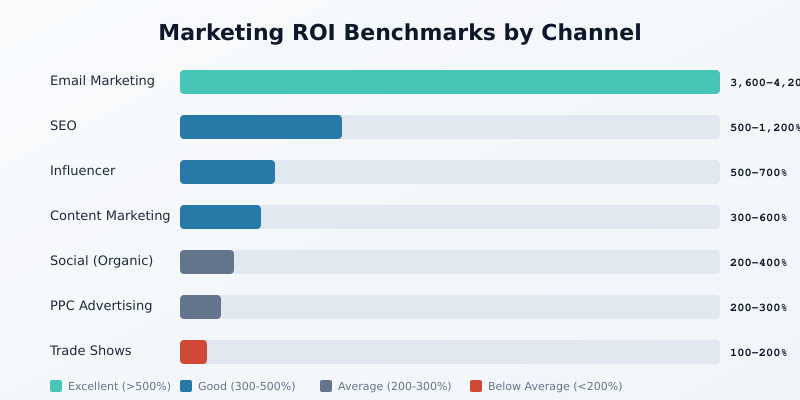
Understanding typical ROI ranges helps contextualize your results. However, benchmarks vary significantly by industry, product type, and business model.
| Marketing Channel | Typical ROI Range | Notes |
|---|---|---|
| Email marketing | 3,600% – 4,200% | Highest ROI due to low costs |
| SEO | 500% – 1,200% | Compounds over time |
| Content marketing | 300% – 600% | Long-term value accumulates |
| Social media (organic) | 200% – 400% | Varies by platform and engagement |
| PPC advertising | 200% – 300% | Immediate but requires ongoing spend |
| Influencer marketing | 500% – 700% | Highly variable by influencer quality |
| Trade shows | 100% – 200% | High costs offset by qualified leads |
A general rule suggests that marketing ROI should exceed 500% (5:1 ratio) to be considered strong. ROI below 200% (2:1 ratio) typically indicates underperforming campaigns that need optimization or discontinuation.
Common Challenges in Measuring Marketing ROI
Despite its importance, calculating marketing ROI presents several challenges that marketers must navigate.
Attribution Complexity
Modern customer journeys involve multiple touchpoints across various channels. A customer might discover your brand through a blog post, later click a retargeting ad, and finally convert after receiving an email. Which channel deserves credit for the sale?
Common attribution models include:
- First-touch: Credits the first interaction
- Last-touch: Credits the final interaction before conversion
- Linear: Distributes credit equally across all touchpoints
- Time-decay: Weights recent interactions more heavily
- Position-based: Emphasizes first and last touches
No single model is perfect. Choose one that aligns with your business model and apply it consistently.
Time Lag
Many marketing activities produce delayed results. Brand awareness campaigns may not drive immediate sales but influence purchases months later. Content marketing builds traffic gradually over years. This time lag complicates ROI measurement and requires patience.
To address this, measure ROI at appropriate intervals for each channel. Evaluate PPC weekly, content marketing quarterly, and brand campaigns annually.
External Factors
Market conditions, competitor actions, seasonality, and economic trends all affect results independently of marketing quality. A campaign launched during an economic downturn may underperform despite excellent execution. Conversely, riding a viral trend can inflate ROI beyond what the marketing itself deserved.
Account for external factors by comparing results to historical baselines and industry trends rather than absolute numbers alone.
How to Improve Your Marketing ROI
Once you’re measuring ROI accurately, focus on improvement. Several strategies consistently boost marketing returns.
Optimize High-Performing Channels
Double down on what works. If email delivers 3,000% ROI while display ads deliver 150%, reallocate budget accordingly. This seems obvious, but many marketers spread budgets evenly across channels regardless of performance.
Reduce Waste in Underperforming Campaigns
Not every campaign will succeed. Quickly identify underperformers and either optimize or eliminate them. Holding onto failing campaigns out of hope or sunk cost fallacy drains resources from better opportunities.
Improve Targeting
Better targeting increases conversion rates without increasing costs. Refine audience segments, improve lead scoring, and personalize messaging based on customer data. Every improvement in targeting efficiency directly boosts ROI.
Test Continuously
A/B testing identifies what resonates with your audience. Test headlines, images, offers, landing pages, and calls-to-action. Small conversion improvements compound into significant ROI gains over time. Our A/B Test Calculator helps determine when tests reach statistical significance.
Negotiate Better Rates
Reducing costs improves ROI mathematically. Negotiate media rates, agency fees, and vendor contracts. Consolidate spending to earn volume discounts. Every dollar saved drops directly to the bottom line.
Marketing ROI vs. ROAS: Understanding the Difference
Marketers sometimes confuse ROI with ROAS (Return on Ad Spend). While related, these metrics serve different purposes.
| Aspect | Marketing ROI | ROAS |
|---|---|---|
| Formula | (Revenue − Cost) ÷ Cost | Revenue ÷ Ad Spend |
| Expressed as | Percentage | Ratio or multiple |
| Costs included | All marketing costs | Only ad spend |
| Use case | Overall profitability | Ad platform efficiency |
| Example | 200% ROI | 4:1 ROAS |
ROAS is simpler but less comprehensive. A campaign might show excellent ROAS (4:1) while delivering poor ROI if creative, agency, and other costs are high. Use ROAS for quick platform comparisons and ROI for true profitability assessment.
Tools for Calculating Marketing ROI
Manual calculations work for simple campaigns, but complex marketing programs benefit from dedicated tools.
Spreadsheets
Excel or Google Sheets handle basic ROI calculations well. Create templates that automatically calculate ROI when you input costs and revenue. This approach works for small teams with limited campaigns.
Marketing Analytics Platforms
Platforms like HubSpot, Marketo, and Salesforce include ROI tracking features. These tools connect marketing activities to revenue automatically, though they require proper configuration and integration with your CRM.
Online Calculators
For quick calculations without spreadsheet setup, online tools provide instant results. Our Marketing ROI Calculator handles the math automatically — enter your costs and revenue to see ROI instantly, complete with interpretation of your results.
Creating an ROI Reporting Framework
Consistent reporting transforms ROI from an occasional calculation into an ongoing management tool.
Establish Reporting Cadence
Set regular intervals for ROI review:
- Weekly: Paid advertising, email campaigns
- Monthly: Channel-level performance, budget allocation
- Quarterly: Content marketing, SEO, overall marketing ROI
- Annually: Brand campaigns, strategic initiatives
Standardize Metrics
Define exactly how you’ll calculate ROI across the organization. Document which costs to include, which attribution model to use, and how to handle edge cases. Consistency enables meaningful comparisons over time.
Connect to Business Outcomes
Present ROI in business terms, not marketing jargon. Executives care about revenue growth, profit margins, and market share — frame ROI discussions around these outcomes rather than clicks, impressions, or engagement rates.
Key Takeaways
Marketing ROI measurement, while challenging, is essential for effective budget allocation and strategic decision-making. Here are the critical points to remember:
- Use the right formula: Basic ROI works for simple campaigns; advanced formulas like CLV-based ROI suit complex scenarios
- Account for all costs: Include direct and indirect expenses for accurate calculations
- Choose appropriate attribution: Select a model that fits your business and apply it consistently
- Benchmark contextually: Compare your ROI to industry standards and your own historical performance
- Measure at proper intervals: Different channels require different measurement timeframes
- Act on insights: Use ROI data to optimize budget allocation and campaign strategy
Calculate Your Marketing ROI Now
Ready to measure your campaign performance? Our free Marketing ROI Calculator makes it easy. Enter your campaign costs and revenue to instantly see your ROI percentage with clear interpretation. No signup required — start calculating immediately.
For campaigns involving conversion testing, pair ROI analysis with our A/B Test Calculator to ensure your experiments reach statistical significance before drawing conclusions.